On burnout, cities, capitalism, AI, ambition, and the forgotten art of having enough.
There is something deeply strange about modern life.
We have machines that can think faster than us, cars that can travel faster than our grandparents imagined, buildings taller than forests, and a small rectangle in our pockets that can connect us to almost the entire world.
And yet, somehow, we are tired.
Not the kind of tiredness that a good night’s sleep fixes.
A quieter, deeper kind.
The tiredness of being permanently available. Of always having somewhere to be, something to achieve, something to buy, someone to compare yourself with. We wake up to an alarm, reach for a phone, fight traffic, sit beneath artificial lights, work for hours, return exhausted, scroll through the lives of strangers, sleep late, and do it all again.
Then we call it normal.
We call it ambition.
We call it development.
We call it life.
Maybe it is.
But sometimes I wonder if we have become so good at living efficiently that we have forgotten how to live.
We have somehow made exhaustion respectable.
“I worked till 2 AM.”
“I haven’t taken a holiday in six months.”
“I barely sleep during the week.”
These sentences are often spoken with pride, almost as if exhaustion proves that we matter.
But the numbers tell a darker story.
The World Health Organization and International Labour Organization estimated that working 55 hours or more per week was associated with an estimated 745,000 deaths from stroke and ischemic heart disease in 2016. Around 488 million people—nearly 9% of the global population in their analysis—were exposed to those working hours.
Think about that.
We have created a culture where having no time is sometimes considered a sign of success.
And then we wonder why burnout has become ordinary.
Perhaps the person who says, “I’m exhausted,” doesn’t always need another productivity technique.
Perhaps they need permission to stop.
There is something Krishna says in the Bhagavad Gita that feels almost rebellious in today’s world:
Karmaṇy evādhikāras te
mā phaleṣu kadācana.
You have control over your action, not over its fruits.
Not a rejection of work.
Not an excuse for laziness.
Something subtler.
Do the work, but don’t hand your entire life over to the outcome.
We seem to have built the opposite philosophy.
Marks.
Salary.
Promotion.
Followers.
Profit.
Recognition.
The result becomes everything.
We don’t simply work anymore.
We work for the next thing.
And when the next thing arrives, there is already another one waiting.
Maybe that’s why the rat race has no finish line.
The student runs towards the exam.
The graduate runs towards the job.
The employee runs towards the promotion.
The company runs towards growth.
The investor runs towards returns.
The consumer runs towards the next purchase.
And everyone keeps running.
But who decided where we were going?
Capitalism isn’t a cartoon villain. There isn’t necessarily someone sitting in a dark room deciding how exhausted we should be.
It’s much more complicated than that.
The system simply rewards more.
More customers.
More products.
More buildings.
More users.
More data.
More engagement.
More profit.
And “enough” is a difficult word to put into a spreadsheet.
Imagine a company saying:
We made enough this year. Let’s stop growing.
It almost sounds absurd.
And perhaps that’s the absurdity we should examine.
Because the planet has limits.
Human attention has limits.
Our bodies have limits.
Our time has limits.
But our appetite for more seems to have none.
You can see the same hunger in our cities.
I don’t hate cities.
In fact, I love what cities can be.
They bring people together. They create opportunities, universities, hospitals, art, food, ideas and possibilities that would be difficult to build in isolation.
But somewhere along the way, we started believing that every empty piece of land was a problem waiting to be solved.
If there is space, build.
If there is a tree, move it.
If there is a field, develop it.
If there is a lake, put something around it.
If there is an empty wall, put an advertisement on it.
We seem almost frightened by emptiness.
But empty space isn’t necessarily wasted space.
A tree doesn’t need to generate revenue to be useful.
A park doesn’t need customers.
A lake doesn’t need a business model.
A quiet road doesn’t need to be filled with traffic.
Sometimes the most valuable thing a city can provide is simply somewhere to breathe.
India’s urban population is already roughly a third of the country, and the number is expected to rise substantially in the coming decades.
Urbanisation will bring jobs and opportunity. It can improve access to education, healthcare and services.
But development should not only ask:
“How much can we build?”
It should also ask:
“How much life can we preserve while building it?”
Because a city is not successful merely because its buildings are taller.
A city is successful when its people can still feel human inside it.
Build your towers.
But leave one tree.
Build your roads.
But leave one quiet lane.
Build your markets.
But leave one place
where nobody has to buy anything
to belong.
And then came AI.
This is where I struggle the most.
I don’t hate technology.
I use it. I benefit from it. I am fascinated by it.
AI can help scientists, doctors, programmers, students and ordinary people. It can remove tedious work and make knowledge more accessible.
But there is a question we don’t seem to ask often enough:
Just because we can automate something, should we?
We can ask a machine to write.
We can ask it to draw.
We can ask it to compose music.
We can ask it to remember.
We can ask it to summarise.
We can ask it to think alongside us.
Soon, perhaps, we will ask it what we should think about in the first place.
And I find that strangely uncomfortable.
Because some things are valuable precisely because they are difficult.
Writing badly and slowly getting better.
Drawing something terrible and trying again.
Learning an instrument.
Cooking without a delivery app.
Walking instead of driving.
Sitting with a difficult question without immediately searching for an answer.
The struggle is not always a defect.
Sometimes the struggle is the experience.
And there is another uncomfortable truth.
AI feels weightless.
You type something.
A result appears.
You type again.
Another result appears.
It feels like magic.
But behind that magic are servers, chips, buildings, cooling systems and electricity.
The International Energy Agency estimates that global data-centre electricity consumption could more than double from 2024 levels to around 945 terawatt-hours by 2030, with AI among the major drivers of that growth.
We don’t see any of that when we click Generate.
That’s the strange thing about modern consumption.
We have become very good at hiding the cost.
Perhaps an ancient Indian idea offers a useful interruption.
The Isha Upanishad says:
Tena tyaktena bhuñjīthā.
A rough rendering:
Enjoy through letting go.
And then:
Mā gṛdhaḥ kasyasvid dhanam.
Do not constantly covet what belongs to another.
How strange this sounds today.
We are taught almost the opposite.
Get more.
Own more.
Upgrade more.
Earn more.
Become more.
Compare more.
But perhaps happiness was never supposed to be a staircase with no final step.
Perhaps there is a point where ambition becomes attachment.
Where improvement becomes dissatisfaction.
Where convenience becomes dependence.
Where technology becomes noise.
Where development becomes destruction.
Where work becomes identity.
Where more becomes the very thing preventing us from enjoying what we already have.
The tree does not hurry.
The river does not check the clock.
The moon does not compare itself
with yesterday’s moon.
Only we seem frightened
of arriving late
to a destination
we never chose.
I don’t want to go backwards.
That’s important.
I don’t want a world without technology.
I don’t want cities to disappear.
I don’t want businesses to stop making money.
I don’t want ambition to disappear.
And I don’t think the past was some perfect golden age.
It wasn’t.
Technology has saved lives. Cities have created opportunities. Businesses have lifted people out of poverty. Science has given us things previous generations could barely imagine.
The problem isn’t progress.
The problem is progress without a definition of enough.
A smart city isn’t necessarily the one with the most sensors.
Maybe it’s the one where a child can safely walk to school.
A successful company isn’t necessarily the one growing fastest.
Maybe it’s the one whose people still have energy when they go home.
A productive human isn’t necessarily the one who fills every minute.
Maybe it’s the one who knows when to put the phone down.
And perhaps intelligence isn’t always knowing what to automate.
Sometimes intelligence is knowing what should remain human.
There is another ancient prayer I keep coming back to:
Asato mā sad gamaya.
Tamaso mā jyotir gamaya.
From the unreal, lead me towards the real.
From darkness, towards light.
I don’t think we need to interpret it as a grand religious command.
Maybe it can simply be a direction.
Away from excess.
Away from noise.
Away from comparison.
Away from the belief that our worth can be measured by productivity.
Towards something quieter.
Something slower.
Something real.
This is why I chose the name noBackspaces.
Because digital life has taught us that everything can be undone.
Delete.
Edit.
Regenerate.
Undo.
Try again.
But real life doesn’t work that way.
There is no Ctrl+Z for a forest.
No undo button for a childhood.
No restore point for a relationship.
No recycle bin for a year you spent completely exhausted.
Some things leave marks.
And perhaps that is exactly why we should be more careful about what we do with our time, our cities, our planet and each other.
Maybe our grandchildren will look back at this strange period and wonder why we were always in such a hurry.
Why we worked ourselves sick.
Why every silence needed a screen.
Why every empty piece of land needed to be built upon.
Why we kept buying things we didn’t need.
Why we asked machines to do things simply because they could.
Why we kept growing when perhaps we already had enough.
And maybe they’ll ask:
“Didn’t they realise they were tired?”
I think we do realise it.
We’re just afraid to stop.
Because everyone else is moving.
The market is moving.
Technology is moving.
The city is moving.
The world is moving.
So we move too.
But maybe wisdom isn’t always knowing how to move faster.
Maybe sometimes it is knowing when not to.
Maybe a good life doesn’t have to be an impressive life.
Maybe success isn’t how much of the world you managed to acquire.
Maybe it is how much of yourself you managed to keep.
Maybe we don’t need a bigger life.
Maybe we need a life with more space inside it.
Space to think.
Space to walk.
Space to fail.
Space to sit under a tree.
Space to talk to someone without checking the phone.
Space to do something badly.
Space to do nothing.
Space to breathe.
Because perhaps the future doesn’t need another voice shouting,
“Faster.”
Perhaps it needs someone quietly asking,
“Why?”
And then, occasionally,
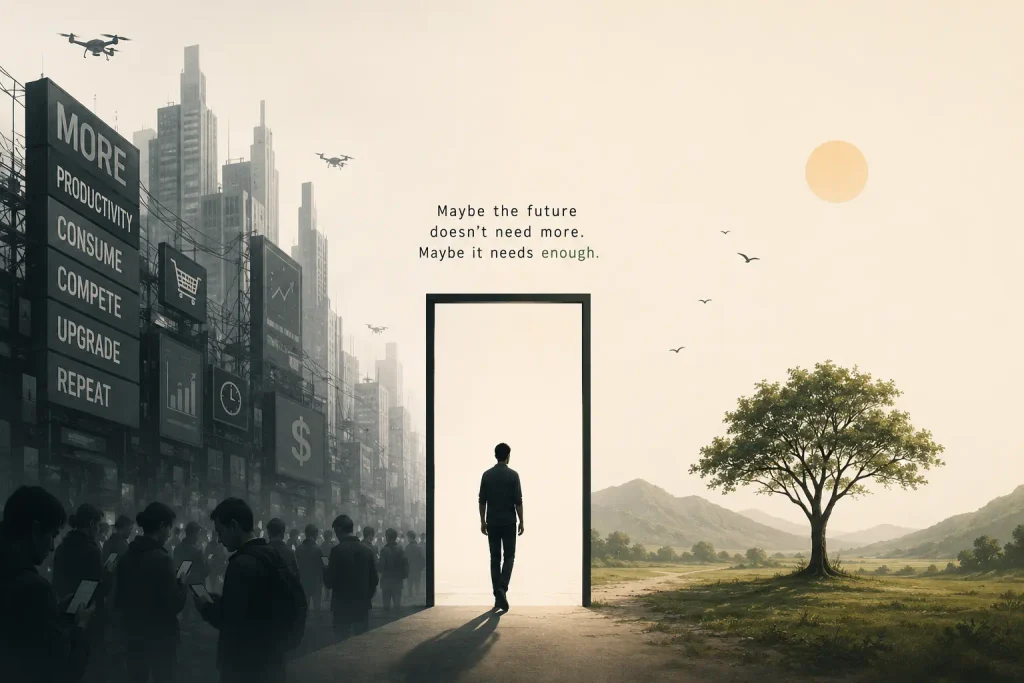
“Enough.”
Welcome to noBackspaces.
For uncomfortable questions about technology, cities, work, money, nature, ambition—and what it means to remain human.
More space to breathe.
More time to think.
Less noise.
Less excess.
More human.